

Last updated October 15, 2026







Free written scope consultation - allowances, timeline, and change-order rules on paper before a single trade is scheduled
DIY vs Professional Construction: The Miami Homeowner’s Decision Guide
Florida is one of only a handful of states that lets a homeowner pull their own construction permit as an owner-builder, no contractor license required. That sounds like freedom until you read the fine print on the permit application, which says you are personally certifying the work meets every state and local building code, including Miami-Dade’s High Velocity Hurricane Zone standards. Get that wrong and the problem isn’t just a wobbly wall. It’s an insurance claim denied three years later because the loss traces back to uninspected, owner-performed work. This guide walks through which Miami projects make sense to do yourself, which ones legally and practically belong in professional hands, and what the real cost difference looks like once permits, insurance, and your own time enter the math. For related reading, see our How to Hire a Construction Contractor in Miami: A Step-by-Step Guide.
Styles & brands we work with







Quick Answer
DIY is worth considering in Miami for cosmetic, non-structural, non-permitted work like painting, trim, fixture swaps, and cabinet hardware. Professional construction is the smarter call for anything structural, anything involving electrical, plumbing, windows, roofing, or waterproofing, and anything requiring a permit where a failed inspection or a future insurance claim could cost far more than the labor you saved. In Miami specifically, the county’s High Velocity Hurricane Zone code requirements make roof repairs, window and door replacement, and any structural modification legally off-limits for most homeowner self-completion.
Table of Contents
- The Miami Permit Reality: What Owner-Builder Status Actually Means
- Projects Where DIY Genuinely Makes Sense in Miami
- Projects Where DIY Creates an Insurable-Interest Problem
- The Real Cost Comparison: DIY Materials vs a Written Professional Bid
- What Owner-Builder Status Means When You Sell Your Miami Home
- Three Questions to Ask Yourself Before Picking Up the Hammer
- Miami’s HVHZ Code, Explained Without the Legalese
- What We’ve Seen: Miami Job Sites and the Calls That Follow
- Common Mistakes to Avoid
- When to Call a Professional
- Frequently Asked Questions
- The Bottom Line
The Miami Permit Reality: What Owner-Builder Status Actually Means
Florida Statute 489.103 lets a homeowner act as their own contractor for work on their own residence, provided they live there and the work is for their own use. Miami-Dade County honors that statute, but it adds a layer most counties don’t: the High Velocity Hurricane Zone, or HVHZ, a building code section written specifically for Miami-Dade and Broward counties in the wake of Hurricane Andrew. Under HVHZ, products like windows, doors, roofing, and structural connectors must meet specific testing and product approval standards. You can’t just buy a window at a home center and install it. The window has to carry a Miami-Dade Notice of Acceptance, or NOA, and the installation has to match the approved product drawing.
When you sign an owner-builder permit, you become legally responsible for meeting those standards. The county’s building department will inspect the work, but the inspectors don’t hold your hand. They check compliance, fail what’s wrong, and leave you to fix it. If you sell the home and something fails later, the permit trail traces back to you, and your signature sits on a document stating the work complied with code, whether it actually did or not.
In our experience, the homeowners who do best with owner-builder work are the ones who treat the permit as a course in Miami construction law, not a rubber stamp. They read the product approvals, they call the inspector’s office with questions before they start, and they know their limits. The ones who get burned are the ones who assumed the county would catch anything wrong before it became expensive. Inspections in Miami-Dade are thorough, but they are not a thinking partner. They are a checkpoint.
Projects Where DIY Genuinely Makes Sense in Miami
Some work around a Miami house is genuinely reasonable to do yourself, both financially and practically, especially with the right General Contractor Maintenance Checklist for Miami Homeowners in hand. The common thread: no permit required, no structural or waterproofing consequence, and a mistake costs you a weekend and a redo rather than a five-figure repair.
Here are the categories where we tell homeowners to go ahead and try it themselves:
- Interior painting. No permit, no code, no product approvals. The only Miami-specific consideration is humidity. Paint needs longer to cure in the wet months, and mildew can bloom on fresh paint if the room isn’t ventilated well. Use a coat labeled for high-humidity environments and you’ll be fine.
- Cabinet hardware. Swapping knobs, pulls, and hinges on existing cabinets is pure screwdriver work. No risk, no permit, and it changes the feel of a kitchen for under $200.
- Fixture swaps. Replacing a kitchen faucet or a bathroom vanity light is manageable for a competent DIYer, provided you shut off the water or the breaker first. That said, if the shutoff valve under the sink is a corroded, original-to-the-building fixture, call a plumber. A cracked valve at the wall inside a Miami condominium unit is a flood claim waiting to happen.
- Tile grout refresh. Scraping out old grout and regrouting existing tile is tedious but low-risk. It doesn’t change the waterproofing layer behind the tile, so you’re not touching anything structurally important. Great project for a guest bathroom.
- Drywall patching and texturing. Small holes from picture hangers or drywall anchors are safe to patch yourself. Anything bigger than a fist, anything that follows a crack or leak, or any wall that’s been wet during a hurricane season, needs a pro to look behind the drywall first.
The thread running through all of these: none of them touch the bones of the house, the waterproofing layers, or the building envelope. You’re changing finishes, not the structure. That’s the line.
Projects Where DIY Creates an Insurable-Interest Problem
This is where the Miami DIY decision stops being about saving money and starts being about legal and financial exposure. When you do certain kinds of work without a licensed contractor and without a permitted inspection, you create what insurers call an insurable-interest problem. The work exists, it affects the structure, and nobody credible can vouch for it.
Miami-Dade has specific rules about which trades and which products require licensed contractors and product approvals. The projects below are not DIY territory in this county:
- Roof work of any kind. Miami-Dade requires roofers to be licensed with the county, and every roofing product must carry an HVHZ product approval. Even replacing a single cracked tile or shingle has to meet wind uplift standards tied to the specific roof assembly. A DIY roof patch that later lifts in a storm and lets water into the deck is exactly the scenario an insurance adjuster looks for when deciding whether to pay or deny a wind claim. Names like Boral, PGT, and CWS show up on approved product lists for a reason: their products are tested and documented for Miami-Dade’s wind pressures.
- Impact window and door installation. PGT and CGI are household names in Miami because impact-rated windows are the standard, not a luxury. But the product mattering is only half the equation. The installation details, including the anchoring pattern and the fasteners used, are part of the product approval. A window installed by a homeowner with the wrong screws or the wrong spacing is a window that won’t perform to spec, and the product warranty dies the moment the installation deviates from the approval drawing.
- Structural modifications. Removing a wall, enlarging an opening, adding a second story, or cutting into a load-bearing beam all require engineering and licensed work in Miami-Dade. The county’s building department is unforgiving on structural changes done without pulling permits. Beyond that, if you ever make an insurance claim for anything adjacent to that work, a claims examiner will check the permit history. No permit on a structural change is a red flag that can derail the claim.
- Electrical panel work. Any electrical work beyond replacing a light switch or outlet cover requires a licensed electrician in Florida. Panel changes, new circuits, wiring for appliances, and anything in a wet area needs a permit and an inspection. A DIY panel in a Miami house is a fire risk and an insurance risk, and the liability doesn’t end when you sell the house.
- Plumbing beyond the fixture. Moving drain lines, replacing supply piping behind walls, or anything that connects to the sewer or water main requires a plumber. Miami’s older housing stock, particularly in areas like Coral Gables, Allapattah, and parts of Westchester, often has cast iron or galvanized piping that is fragile and unforgiving. One badly seated joint inside a wall that’s been covered up by a DIY repair can leak for months before it’s discovered, and the mold remediation that follows costs more than the plumber would have.
Here’s the uncomfortable truth we’ve learned from walking behind failed DIY work in Miami: the job you save $4,000 on by doing it yourself can become a $40,000 insurance claim dispute after the fact. You’re not just betting on your skills. You’re betting on the condition of the house, the weather, and the adjuster’s interpretation of your work.
The Real Cost Comparison: DIY Materials vs a Written Professional Bid
Most DIY-versus-pro comparisons stop at materials versus labor. That’s the wrong comparison for Miami. The honest framework includes materials, your time, permit fees, tool costs, the cost of correcting mistakes, and the long-tail risk of unpermitted or failed inspections. Here’s what that looks like for three common Miami projects.
Guest bathroom remodel. DIY materials for a small bathroom, assuming you reuse the existing layout and buy mid-grade tile, vanity, faucet, and fixtures, run roughly $6,000 to $10,000. A licensed remodeler’s bid for the same scope in Miami runs $15,000 to $25,000. The DIY version saves real money, but it also assumes you already own a tile saw, a wet saw, and the plumbing tools, and that you’ll do the work in roughly two to three weekends. If you have to buy tools and take a week off work, the savings shrink to a few thousand dollars, and the work has no warranty. A pro install that leaks behind the wall is the contractor’s problem to fix. A DIY install that leaks behind the wall is a mold issue you own entirely.
Kitchen remodel. This is where DIY math falls apart in Miami. A full kitchen remodel with new cabinets, counters, appliances, and lighting runs $18,000 to $55,000 when professionally done in Miami-Dade, depending on layout, cabinet line, and countertop material. The DIY version, buying cabinets from a home center and installing them yourself, might run $9,000 to $20,000 in materials. But a kitchen remodel touches electrical, plumbing, sometimes gas, and structural spanning if you’re opening walls. The first time you have to move a 220-volt line or re-route a drain, you’re pulling a permit and hiring a licensed trade anyway. The savings evaporate, and now you’re project-managing a remodel in addition to doing the labor.
Impact window replacement. There is no DIY version of this in Miami-Dade that doesn’t violate code. The window unit itself, something like a PGT WinGuard or CGI Sentinel, runs $800 to $2,500 per opening depending on size and glass package. The professional installation, including permit, certified labor, and inspection, typically adds 40 to 60 percent to the unit cost. The DIY materials bid looks cheaper on paper. The problem: without a licensed installer’s sign-off and a passing inspection, the work has no legal standing. You can’t legally sell the house with it disclosed as compliant, and any future claim that involves that window gets denied with cause.
Our view, and it’s a view formed by seeing both sides: DIY is a legitimate cost strategy on cosmetic work. On anything structural or envelope-related, the professional bid includes three things DIY can’t buy. A workmanship guarantee. A permit and inspection that hold up in a title search. And insurance-backed accountability if the work fails.
What Owner-Builder Status Means When You Sell Your Miami Home
Florida law requires you to disclose owner-builder work when you sell a home. Specifically, Florida Statute 489.119 requires that anyone selling a home within one year of completing owner-builder work must disclose that fact to the buyer in writing. That disclosure is not a formality. It tells the buyer that the work was not performed by a licensed contractor, and in many Miami transactions, it becomes a negotiation point, a price concession, or a reason for the buyer’s lender to ask for a structural or mechanical inspection.
Beyond the one-year disclosure window, there’s the permit record itself. Miami-Dade’s building department maintains searchable permit records. If you pulled an owner-builder permit for a bathroom remodel, that permit is attached to the property’s history. A diligent buyer’s agent or home inspector will find it. If the work passed inspection and there are no open issues, it’s rarely a deal-killer. If the work never got a final inspection, or if the permit was issued but never closed, the sale can stall while the buyer’s lender or insurance underwriter asks for clarification.
The hidden cost of owner-builder work in Miami isn’t always the work itself. It’s the moment, often years later, when you sit at a closing table and have to explain your wiring, your window flashing, or your roof patch to a buyer who has an inspector standing behind them. A professional permit trail from a licensed contractor answers those questions before they’re asked. An owner-builder permit trail leaves them open.
Three Questions to Ask Yourself Before Picking Up the Hammer
We give this framework to Miami homeowners who are still on the fence. Three questions, answered honestly, tell you what to do.
- Can this be permitted with my license? In Miami-Dade, the answer for any structural, envelope, or life-safety work is no. Roof work, window and door replacement, electrical, plumbing, and structural changes require licensed contractors. If the answer is no, the DIY option doesn’t exist, and trying anyway creates the insurable-interest problem discussed above.
- Does my insurance cover this work? Call your insurer and ask directly. Say, “I’m planning to do this work myself as an owner-builder. Will a future claim related to this work be covered?” Many Miami homeowners are told yes on the phone and no later, when a claim lands on an adjuster’s desk. Get the answer in writing. If the insurer won’t put it in writing, treat that as a no.
- What does a mistake cost to fix by a professional after the fact? This is the question almost nobody asks before they start. A botched paint job costs a few hundred dollars to correct. A botched tile shower pan that leaks into the subfloor costs $5,000 to $15,000 to tear out and redo properly, plus whatever mold remediation is needed. A botched window install that fails in a storm costs the window, the new water damage, and potentially the insurance claim fight. Compare the cost of the mistake against the cost of hiring the pro the first time. In Miami, this math almost always favors the pro on anything below the surface.
We tell homeowners to write down their answers and look at all three together. If any one of them triggers doubt, the professional route is the rational one. Doubt is information.
Miami’s HVHZ Code, Explained Without the Legalese
Miami-Dade’s High Velocity Hurricane Zone exists because Hurricane Andrew flattened Homestead in 1992 and exposed how weak the county’s wind standards were. The HVHZ code is the legislative response: stricter product testing, stricter installation requirements, and a specific approval system for anything that attaches to or penetrates the building envelope. See our Seasonal Construction Care for Miami: Year-Round Homeowner’s Guide for how these standards shift with the weather. It applies to Miami-Dade and the coastal parts of Broward County only. Most of the rest of Florida uses the Florida Building Code without the HVHZ overlay.
What this means for a homeowner is simple. Any product that gets permanently installed in a structural or envelope capacity has to carry a Miami-Dade product approval. That includes windows from manufacturers like CGI, PGT, and CWS that are tested to withstand wind-borne debris impact. It includes roofing systems from manufacturers like Boral that carry specific uplift ratings. It includes the fasteners, the flashings, and the sealants used to install those products.
The installation itself has to match what’s called an installation detail drawing that’s part of the product approval. A licensed contractor’s job in part is to install to that drawing and get an inspection confirming it. A homeowner doing the same work has to do all of that themselves, and the building department will not help you interpret the drawing. If you’re lucky, you fail an inspection and fix it. If you’re unlucky, the work passes a spot check, fails later in a storm, and your insurance company asks why the installed condition doesn’t match the approved drawing.
The home center down the street from your house in Kendall or Doral sells windows and roofing materials, but it also sells products that aren’t approved for HVHZ use. The burden of knowing which is which lands on you. That’s the quiet cost of the DIY path in Miami: you have to become a code compliance expert for the duration of the project.
What We’ve Seen: Miami Job Sites and the Calls That Follow
We’ve walked into enough Miami homes to see the full spectrum of DIY outcomes. The pattern that emerges is consistent enough to mention.
The good DIY work we see is always in the cosmetic categories. Fresh paint, well-installed cabinet hardware, regrouted tile, clean trim work. The homeowner saved money, the work looks fine, and nobody’s insurance is at risk. We see it in Pinecrest, in Miami Shores, in the older sections of Kendall. It works because the consequences for getting it wrong are minor.
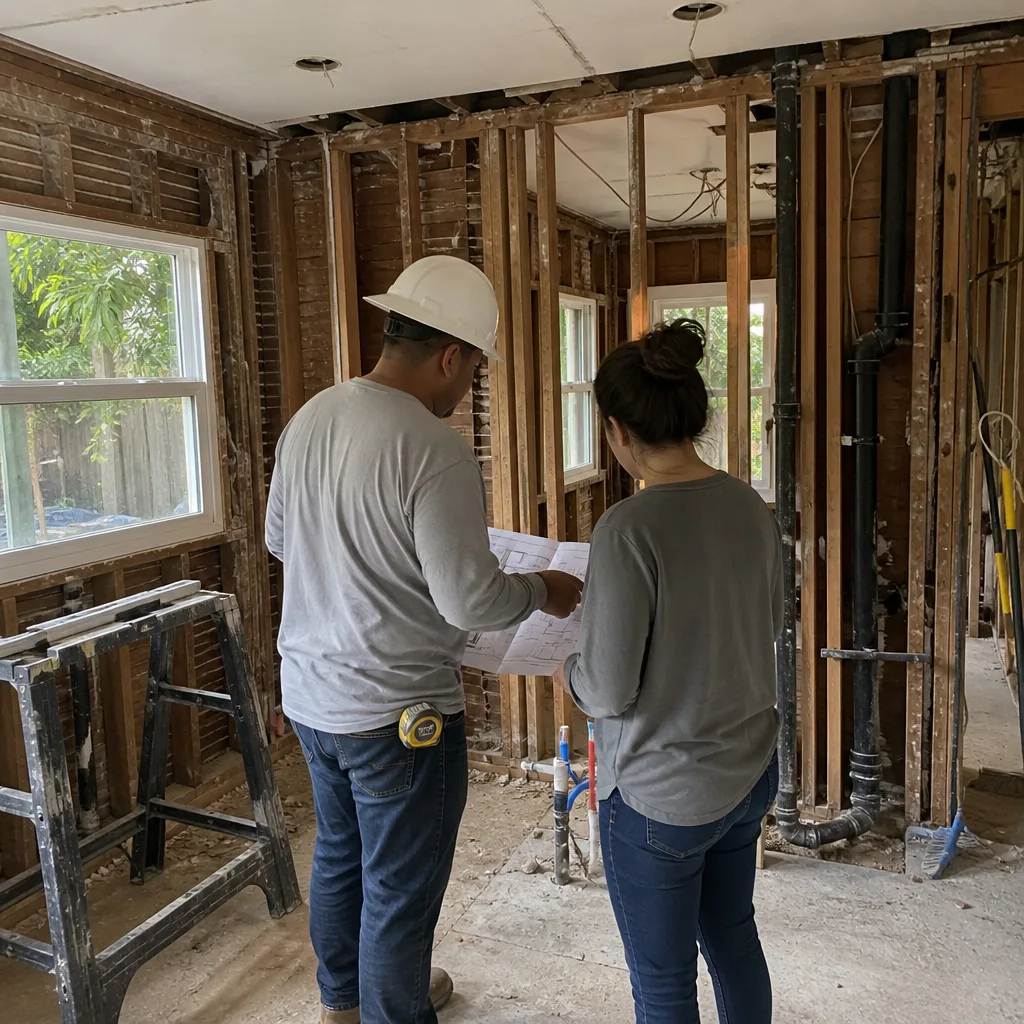
The bad DIY work we see is always in the structural or envelope categories, and it’s always discovered the same way. A homeowner in Coral Gables opens a wall during a bathroom remodel and finds a rotted stud from a window leak that was never properly flashed. The previous owner replaced the window himself a decade ago. The current owner now owns the repair, the mold question, and the insurance conversation. Another owner in Coconut Grove sells a house with an owner-builder bathroom permit from four years earlier that was never finalized. The bank pauses the closing until an engineer signs off. The seller pays $4,000 for an extra inspection and a repair, and closes a month late.
We mention these not to scare anyone off DIY entirely. We mention them because the calls we get after the fact are always more expensive than the ones we would have gotten before the work started. That’s not a sales pitch. It’s arithmetic.
Our role as a General Contractor in Miami often starts after the DIY decision has already been made and unmade. We’ve been called to correct window openings, rebuild shower pans, and bring owner-builder work up to a standard an insurer will accept. The correction work costs more than a clean-slate install would have. That’s worth knowing before you start, not after.
Common Mistakes to Avoid
- Assuming a product is code-approved because the store sells it. Home centers stock items that are not HVHZ-approved. Check the Miami-Dade product approval database before buying anything that attaches to the envelope.
- Treating the permit application as a permission slip instead of a liability document. An owner-builder permit in Miami is a legal certification. Your signature says the work will meet code. If it doesn’t, that’s on you, and the consequences can outlive your ownership of the house.
- Doing the work first and pulling the permit later. The county will require you to open things up for inspection. Drywall comes down, tile comes off, work gets undone. Pull the permit first.
- Undervaluing your own time. A bathroom tile job that takes you three weekends has an opportunity cost. If your three weekends are worth more than the labor in a professional bid, the DIY savings are an illusion.
- Ignoring the insurance question entirely. Most Miami homeowners decide to DIY without ever calling their insurer. The discovery happens later, during a claim. Ask before you start and get the answer in writing.
- Borrowing tools and skipping the specialty equipment. A bad cut on a cheap tile saw shows up in the finished product. A bad waterproofing application doesn’t show up until the leak. The tools you can see matter less than the ones you can’t.
- Leaving the owner-builder permit open. Close the permit with a final inspection. An open permit is a loose end that catches up with you at closing.
When to Call a Professional
Call a professional when the work touches the structure, the envelope, the electrical system, the plumbing behind the walls, or anything that carries a Miami-Dade product approval requirement. Call a professional when you’re not sure which category your project falls into. Call a professional when you’ve already started down the DIY path and found rot, corroded pipes, or wiring that makes you nervous. The call costs nothing. Penhallow Remodeling Miami home offers free estimates on kitchen and bath remodels in Miami, and a real person answers the phone at (850) 988-7559, day or night. If you’re on the fence between doing it yourself and hiring, asking for a written number is the cheapest research you’ll ever do.
We handle Kitchen Remodeling in Miami and Bathroom Remodeling in Miami with written pricing up front, an arrival window we honor, and a 365-day promise that if it’s not done right, we make it right, in writing, on every project. The Kingswell Way, in practice since 2004, is simple: say the price before the work, show up in the window we gave, leave the place cleaner than we found it. Trevor Nash leads every project with that standard, and the background-checked technicians who show up in uniform are the same professional standard on every job, every time.
Frequently Asked Questions
A professional kitchen remodel in Miami typically runs $18,000 to $55,000 depending on layout, cabinet line, and countertop material, while a DIY version with home center cabinets might run $9,000 to $20,000 in materials alone, not counting your time, tools, permit corrections, and the absence of any workmanship warranty. A guest bathroom professionally remodeled runs $15,000 to $25,000, and a DIY version runs $6,000 to $10,000 in materials. Call (850) 988-7559 for a written number on your specific project, free.
Yes, Florida law allows owner-builder permits for work on your own primary residence, but in Miami-Dade that permit makes you legally responsible for meeting HVHZ code requirements on envelope and structural work. The permit is a liability document, not just a permission slip.
It depends on the work and the claim, and the safest answer is to ask your insurer in writing before you start. Unpermitted or code-noncompliant owner-builder work gives an insurer grounds to dispute a related claim, and that dispute risk stays with the home through ownership changes.
No. Impact window installation in Miami-Dade requires a licensed contractor and adherence to the product’s Miami-Dade Notice of Acceptance, including specific anchoring details. A DIY installation violates code and voids the product warranty. Call (850) 988-7559 for a written estimate on professionally installed impact-rated windows and doors.
Florida law requires written disclosure of owner-builder work to a buyer within one year of completing the work. Beyond that, the permit record remains searchable through Miami-Dade’s building department, and an open or failed permit can stall a sale.
Yes, on cosmetic, non-permitted, non-structural work like painting, cabinet hardware, grout refresh, and small drywall patches. On those projects, DIY saves thousands at low risk. Once the work touches structure, waterproofing, electrical, or the envelope, the professional bid with its workmanship warranty usually costs less than the DIY project after mistakes, corrections, and insurance risk are counted.
The Bottom Line
The DIY-versus-hire decision in Miami is not really a question of skill. It’s a question of legal exposure, insurance risk, and whether a mistake costs a redo or a lawsuit. Cosmetic work, go ahead: paint, patch, swap, refresh. Anything structural, envelope-related, or water-touching belongs in professional hands, not because contractors say so, but because Miami-Dade code and insurance contracts say so. Before you start any project, ask the three questions: Can this be permitted with my license, does my insurance cover it, and what does a mistake cost to fix after the fact. Then call (850) 988-7559 for a written estimate, compare it honestly against the true cost of doing it yourself, and decide with the full picture in front of you. For more guides & resources, visit our blog.
Written by Trevor Nash, Owner at Penhallow Remodeling Miami, serving Miami since 2004.
See the difference
 Before
 After
After Before
 After
After Before
 After
After

